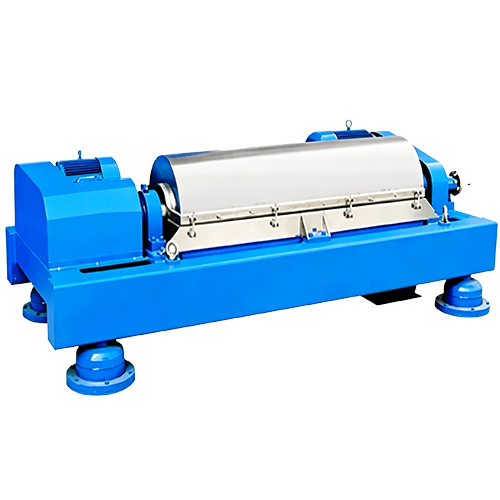
Horizontal screw-discharge sedimentation centrifuges continuously process suspensions with a solids content of 1% to 40%, featuring drum diameters of 200 to 650 mm and a processing capacity of 1 to 100 m³/h. They are suitable for the dewatering of pharmaceutical residue, sludge thickening, and the separation of chemical slurries.
Description
Product Overview
Horizontal screw-discharge sedimentation centrifuges (commonly referred to as horizontal screw centrifuges) utilize a high-speed centrifugal force field to achieve continuous separation of solids and liquids. They produce highly dry residue and are suitable for large-scale industrial production.
How It Works
The material enters the high-speed rotating drum (separation factor 1000–4000) through the feed pipe; the solid phase settles on the inner wall, while the liquid phase forms an inner liquid ring. The screw conveyor rotates in the same direction as the drum but at a different speed (1–35 rpm), pushing the settled solids toward the discharge port at the conical end, while the liquid phase flows out through the overflow port at the large end.
Main Structural Components
Drum (conical section + straight section)
Screw Conveyor (with Wear-Resistant Blades)
Differential (planetary gear or hydraulic)
Main Motor + Auxiliary Motor (or Single Motor + Variable Frequency Drive)
Base, Housing, Shock-Absorbing Pads
Lubrication and Cooling Systems
Core Strengths
Fully Automatic Continuous Operation: Unattended operation; feeding, separation, and slag discharge occur simultaneously.
High processing capacity: Single unit: 1–100 m³/h.
Good solid-phase dryness: The moisture content of the sludge is adjustable from 60% to 80%.
Highly adaptable: Solid-phase particle size 2 μm–5 mm, density difference >0.05 g/cm³.
Good sealing performance: Optional nitrogen-filled seals, mechanical seals, and explosion-proof design.
Typical Use Cases
Plant Extracts: Dehydration of Chinese herbal medicine residues (Andrographis, Isatis root).
Fermentation Industry: Yeast separation, dehydration of antibiotic mycelia.
Chemical Engineering: Dehydration of PVC, PTA, calcium carbonate, and dye slurry.
Environmental Protection: Municipal sludge dewatering; concentration of sludge from industrial wastewater sedimentation.
Food: Separation of juice and pulp, dewatering of soybean pulp, and starch extraction.
Technical Specifications (Example)
| Parameters | Scope |
|---|---|
| Drum Diameter | 200–650 mm |
| Aspect ratio | 3:1 ~ 4.5:1 |
| Maximum RPM | 3,000–6,000 rpm |
| Separation factor | 1500~4000 |
| Differential Speed | 1–35 rpm (adjustable) |
| Motor Power | 7.5–132 kW |
Optional Configurations
Corrosion-resistant materials (2205 duplex stainless steel, titanium)
Explosion-Proof Motor + Explosion-Proof Electrical Control System
Hydraulic Differential (Suitable for Difficult-to-Feed Materials)
Online Cleaning Spray System
Vibration Monitoring and Bearing Temperature Sensors
Support Services
We provide pilot-scale material separation services (using a small, portable horizontal screw centrifuge), issue separation test reports, and recommend the optimal machine model along with differential speed and rotational speed parameters.
-300x300.png "Membrane Filtration (Product)")
-300x300.jpg "Distillation Tank (Product)")
-300x300.jpg "Chromatography Columns (Products)")
Reviews
There are no reviews yet.